
The Big Lie in Dance History: Bodies in the Hall of Mirrors
Enclosure, Extraction, Erasure: The Suppression of Embodied Knowledge in European Dance History, Part II

This is part two of three of a series asking what has been obstructed in our views of our own bodies. Read Part I.
The Man in the Mirror
Most dance classes I’ve attended have demanded attention to the mirrors, or more specifically, the reflection in them. The mirror becomes the authority: get the right line, the right illusion, the right version of yourself. It is the strange fate of a dancer to stare at your own body while you’re in the middle of torturing it for hours, months, years. This was the price of survival in the dance world, from childhood studios to Broadway rehearsal rooms.
But there was always one thing I could never understand in the mirror: my own face. I expected to see an American white man looking back at me. Instead, I saw what someone on a dating app called me a few months ago: “What kind of half-breed are you? Italian?” Years of this line of questioning cloud my view whenever I meet the man in the mirror. And that’s because there’s a 400-year-old ghost staring at all of us right back.
I’m seldom in dance studios nowadays, but this specter also haunts academic writing; it possesses people in conversations who are otherwise intelligent, sovereign. In my ongoing decolonial education, I have come to learn that their own eyes have been clouded by the ghost of The Sun King, one of the most powerful, artificially constructed figures in the propagation of colonization. His image affects us all, and endures when white historians say “the archive.” They rarely mean the truth. They mean the mirror that flatters the image we were told to appreciate.
Every field has its origin myth. Dance’s begins in a room of glass.
When Europe Learned to See Only Itself
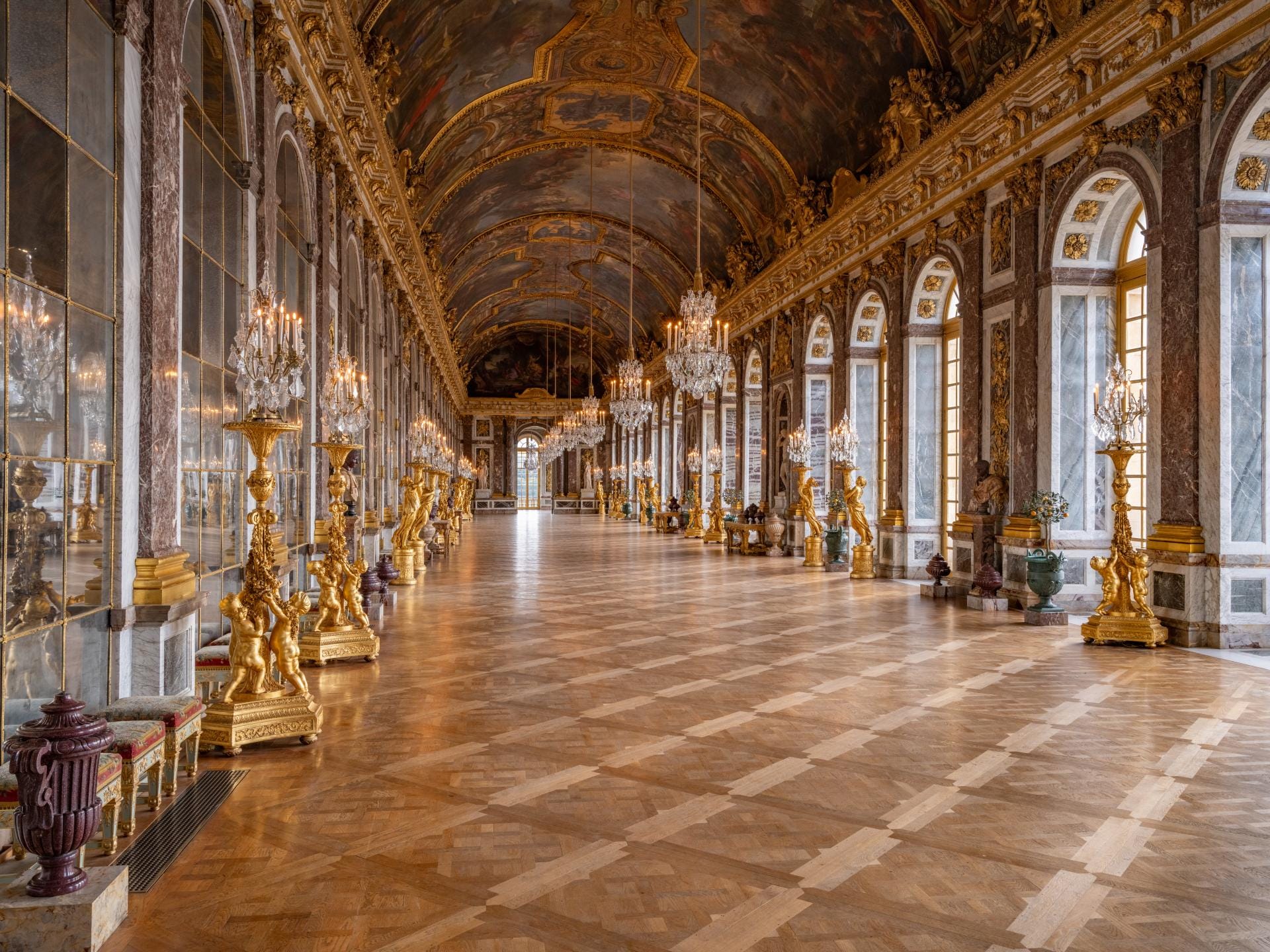
Completed in 1684 under Louis XIV of France, The Hall of Mirrors at Versailles became the ceremonial spine of the palace and the stage where Europe would learn to see its own body. Amidst the many uses and interpretations of the palace’s enormous complex, the hall was designed for one purpose:
to reflect the king infinitely
to make his body appear opulent and omnipresent
to collapse the distance between image and power
to turn divine right into visual fact
Historians of Versailles — Margaret McGowan, Peter Burke, François Bluche — have noted how the palace was engineered to stage absolutism. But still too few dancers and dance historians follow this insight through the body. We miss how the choreography of power in that room became the prototype for the mirrors we inherit today.
Return to the Hall and the logic becomes clear: regal bodies arranged in a perfect cosmic orientation defined and reified for centuries by white male theologians, philosophers, scientists, painters, composers and choreographers. Somewhere in the flashes of mirrors, candles, crystals and windows, this divine order stopped being above, in front, right, centered or wherever the church told you to look. It became everywhere, it became fashion.1 Generations of the wealthy, powerful and aspirational — not only in France but across Europe and the Americas — absorbed these aesthetics so deeply that even when corsets, male high-heels, wigs, crinolines and gloves evolved, the values endured. The choreography of elevation simply migrated from costume to posture, from posture to technique and from technique to the racialized hierarchies of taste that persist today.
With its sumptuous interiors, fashions and customs designed to exalt a purity of whiteness, the Hall of Mirrors is narcissistic surveillance made stone and glass. You do not see “yourself.” You see yourself only in relation to the king. And with so few in mainstream dance or contemporary embodiment practices willing to interrogate these origins, the distorting reflections of Louis XIV’s court shimmer at us still.
This is the function of colonial whiteness and the subjugation of embodied indigenous knowledge in dance.
Ballet as Mirror: Appropriation Turned into Origin
Unlike the quadrilles (square or set dances) that would come a century later, Louis XIV’s court ballets weren’t charming aristocratic entertainments. They were political technology.
Choreographers like Pierre Beauchamp and composers like Lully built spectacles that staged the king as the axis of order. The most famous of these was the Ballet Royale de la Nuit, where Louis appears towards the end as “The Sun King” in a 12-hour ritual that incorporated “exotic” elements like feathers, so-called “Amerindian” motifs, caricatured depictions of African bodies. All represented theft from cultures France was simultaneously colonizing, enslaving or suppressing. All were used to lift up a new king.
What was stolen were not merely adornments but cosmologies: practices that honored land, ancestors and future generations — forms of embodied care that sustained whole communities. Under Louis XIV, these became props in a ritual of absolutism. The king consumed the beauty of other people to elevate himself. The tenderness and relational knowledge at the heart of these cultures was replaced with a choreography of domination.
And this matters because the gilding of the ballroom was not decorative, it was the aesthetic armature of empire. The same king who commissioned ballets to display his divine body also issued the edicts to conquer, enslave and erase. The choreography of spectacle and the choreography of colonial violence were two steps in the same dance. The king’s desire and those of his court were fed at this alter.
This is how the lie was built. Here is how dance history preserved it.
The Archive as Mirror
The surviving livrets and manuals including those housed in elite collections like the Rothschild holdings at Waddesdon, England are not neutral evidence. They are scripts for recreating illusion. They codify violations of bodies, cultures and human rights. They are artifacts of extraction, circulating in a world increasingly hungry for cheap print, portable authority and standardized visions of “proper” movement. These documents did not merely record steps; they established traditions of value that shaped later laws, cultures, universities and even the forms of resistance that emerged in their shadow.
Centuries of dancing masters — many concealing their own identities — polished the king’s fantasy. Fantasies of dancers so elevated by whiteness they could “dance on their toes” (en pointe) strive to erase the source communities entirely. Dark-skinned villains, “primitive” costumes and white-washed fashions codify stolen aesthetics. The manuals make us pretend the mirror is a window. They train us to mistake illusion for knowledge.
The archive is not memory.
The archive is inheritance.
When I sit in a dance history conference and watch colleagues’ eyes glaze with an invisible flash as they skip over what every marginalized dancer in the room can see plainly, I witness how generations of scholars have mistaken reflection for fact. Whiteness’s compulsive search for what is already guaranteed — power — is the real ‘dark’ ritual of the Hall of Mirrors. It is why white dance scholars keep returning to the same hollowed-out bones of the manuals, still looking for the King. It’s why those of us recognizing suppressed embodied lineages are still cast aside while they still have “important research” to do with manuals, the prints of court dances and the costumes that will never, ever create the meaning they are looking for because it was never there.
It is an empty, insatiable hunger whose destructive force has been confirmed for centuries by Black and Indigenous scholars, by dancers at the margins, by communities systematically repressed. It is the desire to be a king.
The Manuals That Maintain the Myth
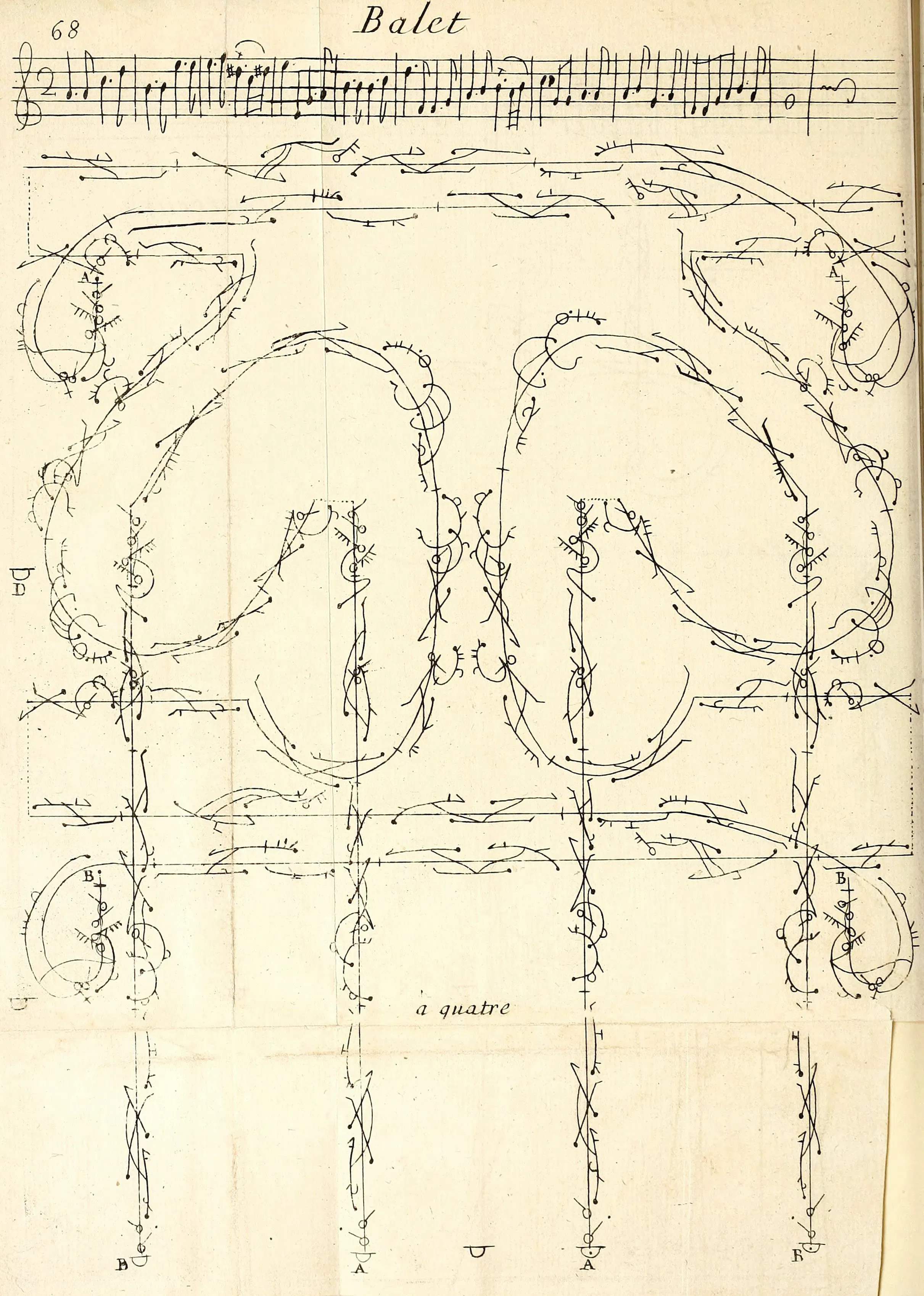
Beauchamp–Feuillet notation, Rameau’s Le Maître à Danser are manuals claiming to describe “how people danced.” Not only are they absolutely atrocious to read and are about as nonsensical looking as you can imagine, scholars like Susan Leigh Foster and Rebecca Harris-Warrick remind us, these are not innocent texts. They are:
political artifacts
technologies of discipline
imperial aesthetics
tools for exclusion
They preserve and uplift what the powerful wanted remembered and not what was actually unfolding in the world. Who and what was repositioned?
African diaspora dance
Romani social dances
Indigenous dance
rural improvisation
working-class bodies
embodied knowledge outside the court
These are the ghosts the mirrors refuse to reflect.
The Three E’s: Enclosure, Extraction, Exclusion
When the gold and velvet are stripped away and the mirror is shattered, the machinery illuminated across disciplines by political economists, de-colonial theorists and archival scholars comes sharply into view. It’s the simple, dumb colonial technology of enclosure, extraction and exclusion.
This is how colonial systems operate on land, on bodies and on knowledge. Louis XIV’s dance world was not separate from this logic; it perfected it.
Enclosure.
Movement was centralized in the court, yes — but even more importantly, knowledge was enclosed within a small circle of men who produced and transmitted the choreography. The Beauchamp–Feuillet system didn’t arise from open artistic exchange; it arose from an elite, guild-like network of dancing masters, court officials and royal academicians whose access to manuscripts, rehearsals, treatises and royal commissions was tightly restricted.
In this sense, the world of early dance notation resembles other imperial knowledge enclosures:
• the Casa de la Contratación in Seville, where mapmaking was secret and punishable by death;
• royal academies whose membership conferred political rather than purely artistic authority;
• court musicians and dancing masters whose livelihoods depended on guarding knowledge, not democratizing it.
Dance notation did not reveal anything about the world; it regulated who had the right to move inside it. Versailles becomes the only legitimate source of “European dance.” Colonial cities, churches and palaces are placed upon Indigenous burial sites and places of profound spiritual meaning. The logic is the same: enclosure produces legitimacy, and legitimacy erases what came before.
Extraction.
Rhythms, aesthetics, rituals and meanings were lifted from Romani, African, Indigenous, Mediterranean and working-class European communities — and once absorbed into this closed circle of court choreographers, these knowledges were declared no longer belonging to the people who created them. They became royal intellectual property. They became court knowledge.
This mirrors imperial cartographic extraction: the empire learns from you, maps you and then claims your world as its own.
Exclusion.
The same select circle that enclosed and extracted knowledge also decided who counted as a “dancer,” whose movement had value, and whose bodies should be erased entirely. The manuals survive because the people who made them controlled the archive. In the colonial gaze, communities who created the aesthetics survive only in distortion or silence. Rhythms, aesthetics, rituals and meanings are stolen from colonized and marginalized peoples, and the discarded bits are called “noise” or “low”. Dances are weaponized against their own communities.
And here is the part that is hardest for me to say, but necessary: this machinery did not disappear with the 17th century. It is still upheld — often fiercely — by fellow scholars who inherited its authority rather than its truth. Their confidence is not rooted in deeper research or greater insight but in their proximity to the old gatekeeping networks that once controlled access to manuscripts, guild knowledge and royal favor. The same false certainty that guarded the Beauchamp–Feuillet circle still appears in conference rooms, review boards and academic publications, where outdated frameworks are defended as though they were natural law. It is not scholarship that keeps this worldview alive. It is habit, hierarchy and fear. False certainty is the modern Hall of Mirrors: a reflection mistaken for depth, authority mistaken for understanding.
This is racial capitalism in motion draped in the fake elegance of court choreography. Its grotesqueness grows as generations of scholars imbue this machinery with meaning that was never there. The decadence of this world was not noble; it was brittle, wasteful and terrified of its own emptiness.
And here is the truth audiences and dancers alike feel instinctively: that first reaction people have to ballet’s rigidity (that sudden “what is this?”) is not ignorance. It is the body recognizing a structure that was never built for its freedom.
When My Body Recognized the Pattern
Recently, in a contemporary academic setting, I watched enclosure–extraction–exclusion unfold in real time inside an institution that believed it was opening its doors. My identity and presence were welcomed for the promotional materials, and then accidentally removed from the event itself.
I hated myself for letting it happen. Then I hated myself for recognizing the pattern so clearly — a pattern my de-colonial and anti-racist colleagues had taught me to see — and still trying to deny it. Disruption was seeing that my body understood the choreography of harm long before my mind was willing to admit it.
The moment I named the three E’s, something in me regulated. Not because the harm disappeared, but because the mirror stopped working on me. I knew exactly what kind of dance I was in and what was really happening behind the glass. Bright, shiny things no longer hid harmful motives. I abandoned reflection for truth, letting my body finally metabolize the structural violence I had been dancing inside for years. I forgave. Once I stopped performing for the mirror, I could finally see the others still caught inside mirrored corridors of oppression. I better understood those whom the mirror privileges.
Thomas DeFrantz calls this “the Black body’s refusal.” Ann Cooper Albright argues that the body knows what the archive represses, and I’ve loved dancing in her barefoot contact interventions in those long, stuffy conferences. For me, it wasn’t just about not looking in the mirror anymore. It was about stopping my attempt to be the mirror for the world in my own dance, in my own body.
Since that moment, my body has refused. I eliminated dancing for many years in a necessary reset. Today, I am working on a new video series dancing with roads, something very familiar to me and my family for generations. It’s a journey I can offer to you. This is how I know to rebuild and share right now. And this is exactly what the system fears:
Once you see the code in the choreography, you can choreograph the code.
The Mirror That Never Reflected Me
In many contemporary dance spaces, the toxicity of mirror culture is well understood — and rightfully so. But the task is not the same for every dancer. “Turn away from the mirror” reveals something important: it only feels liberating to dancers who never needed the mirror to belong in the first place. White dancers, including many in somatic lineages, can treat the mirror as optional because the state mirrors them everywhere else. The studio reflects them. The choreographic imagination reflects them. Their bodies are already legible.
For non-white dancers, the mirror is not a tool to be easily discarded but a demand. The colonial gaze polices the body whether the glass is present or not.
This is the same logic that makes barefoot dancing “authentic” and “classy” when done by wealthy white dancers, yet “improper” or “trashy” when done by under-resourced or racialized dancers. This dynamic is perhaps done without full self-awareness, but it nonetheless strips many dances of ancient, living knowledge and replaces them with techniques and exercises rebranded as “discoveries” within a capitalist wellness economy.
Somatic rooms talk about healing and presence, but most avoid history, colonization, racialized embodiment, and the political labor of surviving erasure. Somatics without history is another mirror — softer, kinder, but still a mirror. Turning away from mirrors liberates only those already reflected without distortion.
The real question is not whether mirrors should be used, but who were the mirrors built for.
As white presenting gay Romani man, I had a body that never quite fit the rooms I was allowed to enter, so the mirror became survival. I learned early which parts of myself were “acceptable” in public and which were not — a calculation many people never have to make. For years I clung to that damn mirror waiting for what was never going to be offered.
Covering mirrors in a studio does not dismantle the structure. It simply hides it. This is the Hall of Mirrors at work: a structure of belonging masquerading as a tool of awareness. Sadly, so many in our world (more every year it seems as we lose the arts, nature, even science now) were never taught to feel what they feel, let alone remember that they, too, came from somewhere else.
This is an archive — a repertoire of lies — that the mirror was built to reflect.
Community as Mirror: Moving into the Counter-Archive
For me, the truest reflection was never glass. It was my community — shared, uncertain, alive. When the studio mirror tries to define me, diaspora knowledge interrupts it. For example, when my foot hit the floor in Ireland, my body was not expressing an “Irish shape.” It was having a conversation between Romani lineage and colonial imprint. It is dancing in the kitchen with my Irish friends.
The mirror is kumpanija. Mahala. In Vogue/Ballroom it is the House. It is a family’s rhythm pulsing through the ups and downs of life. Belonging creates the mirror, not the other way around. I have found Irish set dancing — and the eco-somatic practices I learned in community in North Clare — work this way too, and they have been among the most joyous parts of my Irish-American life.
If community — its connections to land, to those who came before and those who come after — restores a more accurate mirror, then what kind of knowledge does it generate? In Part III, I will outline what I believe that knowledge is, and how learning to dance with time itself can become resistance, protest, recovery and liberation.
This is why community dances feel alive: they are held by people, not institutions. The counter-archive does not begin in the Hall of Mirrors. It begins with those who were never allowed to see themselves reflected there — and danced anyway.
The ghost of the Sun King still lives on in the piece of glass in your hand. It no longer needs court ballet or academic ceremony to obscure your view. Windows became mirrors. Mirrors became screens. Truth became whatever power wants us to see.
Continue onto Part III
I am simplifying the complexity of the medieval and early renaissance church. But I do believe there is a pattern here: fashion became the new church.
Oh, fascinating article! I definitely want to read everything you write about dance, you're uniquely positioned to illuminate the oldest and most pervasive case of cultural appropriation and orientalism in the west. It's quite incredible that we're still having these conversations (think, Rosalia insisting that Flamenco doesn't only belong to the Roma, while using a slur) while actual Romani artists are doubly marginalized. Goran Bregović got famous off of plagiarism and cultural appropriation. If I were to count the most egregious instances, I'd be writing a novel-length piece. As a middle Easterner, when I see such things happening, I get to figuratively smack people over the head with Said's book, the Roma get no such privilege because stealing their traditions and discriminating them at the same time is basically a pillar of European cultural identity.