
What really happened to indigenous Europe? Dance knows.
Enclosure, Extraction, Erasure: The Suppression of Embodied Knowledge in European Dance History, Part I

What was taken from you?
If something was, your body already knows.
What we call colonization did not just take the world. It colonized its own body. Dance is the evidence….and a method to freedom.
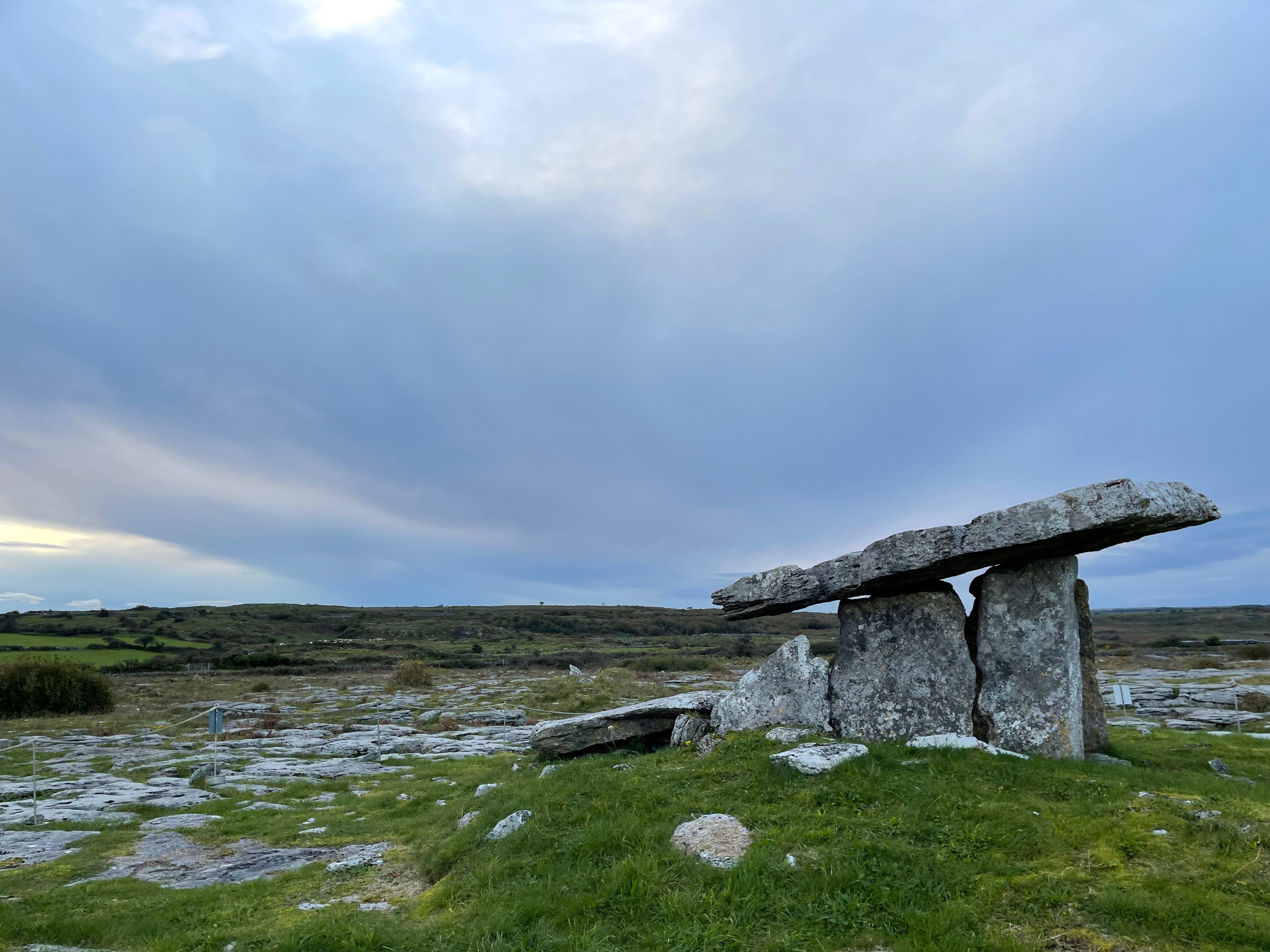
In the chilly dusk of autumn, I stood near a 5,000-year-old limestone portal tomb and watched the moonrise. Nearby a farmer gently watched his enormous, terrifying cattle balance across the rocky landscape. I had invited a fellow American to come with me. We read the display signs indicating this was a pre-historic grave site.
“This isn’t a grave. This is a magical portal,” she said.
In that moment, something felt off to me. It was as though she suggested there was some other power at work here, and that it was hidden. In time, I would come to understand that I had a different experience of this historic site. I wasn’t seeing some reflection of secrets and ancient magic, I was seeing the awesome majesty of humans anchoring love, grief and community in time and place for millennia. What could be more magical than that?
Dance, spirituality and history cannot be separated from the body or the land beneath it, and if we want to better understand our relationship to them, we should restore our understanding of our life’s dance through the lens of time.
In this series I’m asking us to confront how deeply our histories, bodies and fields were shaped by that theft and what liberation can mean. I’m also demanding better academic research into our history, which is and has always been embodied. I don’t want to hear about how “we can’t know how people in the past were feeling” when we have woodcuts and pictures of people in chains and being butchered. You may not know how they felt, but epigenetics suggests that their descendants do. The explosion of modern spiritual practices and the wellness marketplace indicates we’re looking for answers to the past’s traumas. Or maybe the trauma never ended. Empathizing with those who came before us is honest, and I also think it’s academically rigorous. It could also be life-saving today.
For thousands of years Western Eurasia — a large, highly diverse region of cultures and ethnicities — has been intimately part of a Asian, Mediterranean and African world. A lot of people jump to “New World” Atlantic World discourses, but these can end up centering Europe and a fictional geographic center of whiteness, cutting off people historically from the rest of the world. This dangerously isolates people who belong to the rest of the world as much as the world has been coerced to belong to them. So much of de-colonial work I believe is recognizing the false boundaries between us that prevent us from living from universal truths of the human experience. It is recognizing the enormous cost of creating a world where some people are a little or a lot better than others.
The risks of allowing false divides to endure are becoming clearer as we witness threats to life in the form of mass planetary extinctions currently unfolding. We know from modern psychology the dangers of isolation and how loneliness can fuel hate and colonization, and this is my primary motivation in posting this series, and for this newsletter. Dance belongs to everyone, and, especially if you’re white, there is a very good chance you had yours stolen from you. Personal reclamation is part of this journey.
I love Europe and my life has been saved and transformed by friends and communities there. I am also grateful to my Indigenous, Palestinian and allied friends for opening my eyes America’s ongoing colonization, and to the colonization of my own people, the Roma and the Sinti.1 It is from this life-saving gratitude that I offer this invitation to question what has been taken away and in turn, what the body remembers and can never be taken away.
What I want to call out, as directly as I can, is that we cannot understand our global history without asking what was done to European bodies and what European bodies were no longer allowed to do. As I will cover in the next part, something truly astonishing happened to embodied self-perception and autonomy in the creation of ballet in particular, and understanding that process and how it endures is essential to building autonomy.
No other field tells the story of Europe’s internal colonization more clearly than dance.
Every other discipline can escape into abstraction: text, numbers, theory, categories—ultimately control. Dance cannot. Dance forces us to stay with the human being in motion.
Please let me clarify that I have no problem with anyone studying ballet or the dances of white people. Ballets Russes remains one of my greatest inspirations when I do dance theater, and the hard work of ballet dancers is extraordinary. I do however, have a problem with calling that the dance: insisting that all real dance comes from ballet.
I remember when someone confronted me and said I must have studied ballet because of how I danced. I took a single quarter-semester at University of Cincinnati College-Conservatory of Music. That was it. But in their mind — and in the mind of my partner at the time — it was impossible to dance with integrity without ballet. Everything else was a joke. This is not an aesthetic position. It is a colonial one.
You can try asking yourself this question. Is dance just ballet or something people do for fun or fitness? Or is dance the study of who we are, how we move, how we express, how we live in our bodies? Within dance studies, this difference is everything. The first story reproduces the empire. The second begins to unravel it.
Here is another clue: Where do you turn for healing, belonging, and spiritual grounding? What dances and culture support you in this and which do not?
For centuries in an American context, white folks have turned to African-American, Indigenous American, Asian, Latin American and Romani dances and embodied knowledge for belonging, healing, spiritual support, courting, mating, and more. They do this because something was taken. Their own ancestral embodied knowledge — the stuff that lives in rhythm, gravity, breath, repetition, communal timing — had been taken away or lost, and in time American white Christian patriarchal consumerism gave them so much more.
If something is missing, the body goes looking for it.
Or support my work by ordering my independently published dissertation,
Feeling Impact: A Timedancer’s Study of Irish Step Dance
I love archival, time-period-specific research, where the legacy of this problem can be easily observed. I have been in many meetings where privileged, egotistical historians insist that everyone else is “doing the archives wrong.” One American scholar who works primarily out of France rolled her eyes at the mere mention of other dance cultures beyond ballet.
They hold some imagined center: “We are the true keepers of high-quality historical research.” Meanwhile, the primary sources they rely on do not make any sense.
They look at dance manuals and a handful of well-trodden sources, just in more depth — and believe they have captured “dance history.”
Meanwhile the bodies, the folk forms, the communal improvisations, the rhythms of working people, the ecstatic dances, the migrations, the survivals and the refusals are nowhere to be found in their origin stories. Even worse, they do nothing to support the traditions and people in Europe who are actually preserving and re-discovering these practices.
This erasure is not an accident. It reflects a deeper erasure of Indigenous Europe and of Europe’s relationships with Africa, the Mediterranean and Asia. It ignores the many people from somewhere else who are part of its history and the racial diversity that has always been part of Western Eurasia’s dance. It ignores that we all came from Africa.
In an education context, as long as we keep saying that dance studies is just tutus and turnouts, we will lose whatever small foothold we have in the wider world. We will lose funding. We will lose power. And within our disembodied colonial system, we will lose the last traces of knowledge native to every single person on this planet: how to live in a body.
Within the dance world, anti-ballet sentiment is not new. Modern and contemporary choreographers have been addressing these issues for a century. Their bodies know something is wrong. They make new futures because they had no choice. But narratives matter, and we must begin telling truer ones.
In somatic dance spaces, tremendous strides are being made to dance from the body. But even there, intellectualism sometimes overrides humanity. We tend to dance “the inhuman”: technique, energy, line, clinical anatomy. We hesitate to dance what is undeniably human: heartbreak, lust, displacement, longing, anger, connection, transformation. Pina Bausch never hesitated. She and her decentralized dance company remain a reminder that the body is always telling the truth.
I am not saying I have all the answers. I am not saying I’m going to get it all right. I am saying we must ask better questions, and we can do so when we do so in and with motion. I discovered something was deeply wrong in western dance history during my master’s degree, long before I fully understood how this would shape my own self-perception. It was the researcher in me who noticed the gaps and the dancer in me whose body refused the lie. Just because someone said ballet is the origin does not make it true. Just because the archive is silent does not mean the body is.
In the next part of this series, I turn to the machinery itself: the manuals, the archives, the academic habits, the nationalist projects, and the colonial frameworks that built this lie in the first place.
Continue to Part II
I am not Sinti, but friends and elders are. Regardless, I always seek to recognize them in my work.