
Freedom Beyond Light Supremacy: Painting Dance
A meditation on color, embodiment and the Romani sacredness of darkness

Jackie has been teaching me to paint my dance. I used to think color was something we saw, but lately I’ve come to understand it as something we feel—a story of liberation from colonial narratives perpetuated in light and dark.
At a summer camp on water ecology in high school I had a friend who was taught all the wrong names for colors by her older brother, and purple-for-orange haunted her into adulthood. I know it sounds poetic but it really was not for her. I, however, learned the standard English names for color and how to see them, but my interest in visual arts education stopped there. Puce, teal and ochre remained fabulous, unpainted words to me. Over a dinner of Daire’s tacos, Jackie—holding up a glass of champagne to the light coming from Daire’s nourishing fairy garden—showed us a tawny pink that could not be captured in paint. It just seemed to happen. I began to feel color.
This was not however the first color that she showed me. In early August of 2025 as Israeli-induced famine began to set in on the people of Gaza, she drew a red line. When I saw it, I remembered when my Palestinian colleague Eva once said to me:
The war started in 1948 and never stopped. My family is grieving.
Perhaps the red line suggested, in my slowly decolonizing brain, that war lived somewhere on one side of it. But genocidal famine became the watercolor stroke itself—bleeding through the page. Through the fading, pressing and splattering of a brush we drip into a massacre without beginning or end.
As I feel the falling of self and society, the “enlightenment” tropes of knowledge-as-light, goodness-as-white, bad-as-black appear to comfort me. Suddenly insides are dyed with shame and bright fantasy blinds the truth of the human experience. This is ancient patterning.
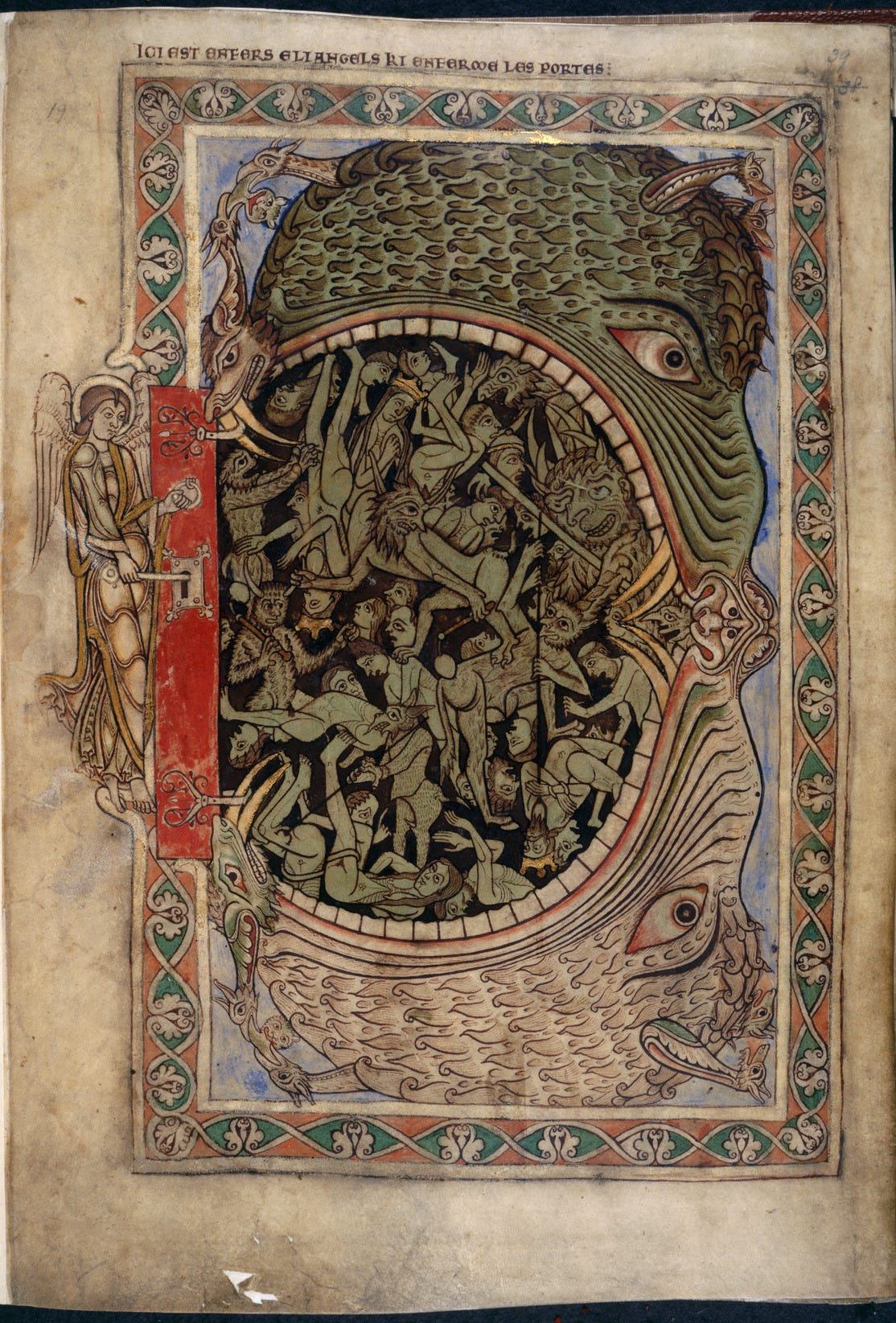
,_f.39_-_BL_Cotton_MS_Nero_C_IV.jpg)
In the medieval liturgical imagination, Satan was painted black and stripped of song. In The Play of Adam—a twelfth-century church drama that helped stage the Christian cosmos—he enters “niger et deformis,” black and misshapen, unable to make music. The absence of melody marked his distance from divine order; blackness became a sonic and visual shorthand for separation from grace.
Through these performances, the Church taught that to be outside the light was to be outside harmony itself. Empire later translated this theology into philosophy: the Enlightenment’s worship of illumination and purity recast whiteness as both the form, while darkness became its necessary proof of ignorance. Our senses, our colors, our bodies—what did not reflect that light—were cast into shadow.
And yet artists have always known otherwise.
Creatives can move outside this dualism, so often showing us that when life does not seem to work out, it is the secrets in the “shadows” that set us free. Scholars like Fred Moten remind us, blackness is not the opposite of light but the condition of its possibility. What if the dark is not the opposite of knowing, but the place where knowledge begins to breathe again? What happens when we stop searching for light beams while we break upon the brown earth around us, blind to the blackness holding us in space to the beginning of our time?
Emmylou held me a bit this week as the war against journalism escalated to the murder of the Al Jazeera reporting team in Gaza. When I worked at Fortune Media (of the Fortune500) at the end of the 2010s, my colleagues were already sounding the alarm that journalism was in peril—clickbait quotas, billionaire buyers of the press, the murder of truth-tellers like Jamal Khashoggi. A working man was killed for speaking the truth about a very rich man. We never received justice.
Emmylou’s planting of poverty in the red dirt of Mississippi stains my fall:
“One thing they don’t tell you
’Bout the blues when you got ‘em
You keep on falling
’Cause there ain’t no bottom
There ain’t no end.”
— Emmylou Harris, “Red Dirt Girl”
Sounding through African-American life for centuries, blue resists swallowing in the abyss of the annals of agony. If we take the mariner’s gaze upon the horizon of our torment, worlds of deep indigo, ethereal gray and churning yellows bring us through changes of weather, time and tides. Clairvoyance (clear-seeing) invites us to open our eyes and articulate landscapes.
In my work with the North Clare Dance Creamery, Maria has explored the colors of the seasons of her life and given us the privilege to feel them dwelling with us. In my own body, I change with the seasons and with my movement across the earth. In the North, the pallor of my ancestors returns, adapting me to the winter. Toward the equator, my Romani ancestors prepare me for the sun’s weight. My deep brown eyes invite strangers to Kalipen—blackness in Romungró, my critically endangered Romani dialect. With ties to the ancient Indian goddess Kali and, more recently, our patron saint Sara Kali, darkness is sacred: pointing to time, to origins, to infinity.
What have we painted across the lives of others from what we have done and said? Named colors are for rainbows, bedroom accent walls and fascist ball caps. Unnamed colors can set us free. It is all the blank space around the words, that is why poetry needs so much empty page. As I look out at the sea in Lahinch at 6:30am, my tears water the green dancing above the cliffs in the bay. I fall into myself, and in the drop, I see color—all the way through.